That was quick!
In my last post I said I had given myself a deadline of Sunday, July 18, to complete studying particular sections of the Famous Artists Course and the Famous Artists Cartoon Course. Well, it's now SEVEN DAYS since I first made that pledge (on June 19) and guess what?
I'm done studying the Famous Artists Courses material!
Yes, I'll admit that I went through some of it quickly but that was mainly due to redundancy. And I'll also admit that my desire to start putting my new-found knowledge to practical use has become impossible to ignore.
I want to get back to work on TOYS!
I'll continue to work on the Nicolaides curriculum. But starting tomorrow, I'm back to my story!
I can't wait!!

Nicolaides—Schedule 4 complete
Another Nicolaides schedule done and another's been started.


I did another calculation and determined that—if I continue to complete one schedule per week—I will complete this in October. Originally, I didn't think I'd be done until December so you can imagine how excited I was to learn this!
Another significant decision—I'm finding that systematically studying drawing is already helping with my observation and recording skills. But I'm getting a little too dependent on the studies. In other words, I've developed a slight fear of leaving the studying behind temporarily so I can apply it to my film.
But that was the point of studying in the first place, to make my next film look significantly better than my last.
So I set a deadline. I'm currently studying the head and figure from the Famous Artists Course (not sure if it's the Illustration or Commercial Art course) and from the Famous Artists Cartoon Course. Once I'm done with those chapters, I'm back on "Toys." THAT deadline is soon, Sunday, July 18.
And here's the best part! I recently did some brainstorming for the Toys storyboard and found myself drawing the figure and heads better than I've ever drawn them before! It's amazing how little drafting knowledge I had. What made me think I could fake it?!
Onward!


I did another calculation and determined that—if I continue to complete one schedule per week—I will complete this in October. Originally, I didn't think I'd be done until December so you can imagine how excited I was to learn this!
Another significant decision—I'm finding that systematically studying drawing is already helping with my observation and recording skills. But I'm getting a little too dependent on the studies. In other words, I've developed a slight fear of leaving the studying behind temporarily so I can apply it to my film.
But that was the point of studying in the first place, to make my next film look significantly better than my last.
So I set a deadline. I'm currently studying the head and figure from the Famous Artists Course (not sure if it's the Illustration or Commercial Art course) and from the Famous Artists Cartoon Course. Once I'm done with those chapters, I'm back on "Toys." THAT deadline is soon, Sunday, July 18.
And here's the best part! I recently did some brainstorming for the Toys storyboard and found myself drawing the figure and heads better than I've ever drawn them before! It's amazing how little drafting knowledge I had. What made me think I could fake it?!
Onward!
Notes about Nicolaides
I'm continuing to work my way through the Nicolaides curriculum. I thought that once I'd gotten through the boring blind contours, things would pick up. Then I got to the modelled exercise!
Essentially, I like the exercise and I believe it has a benefit. But maybe it's one of those things that requires a live model because working from photos doesn't quite work. The predecessor to modelled was the weight exercises; modelled is weight with contours indicated. Unfortunately, it doesn't quite work as described.
But I'm not giving up on it. I simply treat the modelled exercises like the weight exercises and leave it at that. I think it's ultimately important to have the experience and to think a certain way while drawing as opposed to the final result.
FYI, for the gesture exercises and similar others, I'm using a stack of pictures I pulled from surfing magazines, skateboard magazines, etc. Anytime I saw a picture of a person in a dramatic action pose, I tore it out of the magazine or printed it. Glad I did because they're substituting for live models.
Another resource I have is this book:

This book has become invaluable for the weight/modelled exercises due to the multiple angles of nude models.
There is one exercise I simply cannot do without a model and that's the Descriptive Pose exercise. One is to describe a pose in words, draw it, then have the model take the pose to draw what it actually looks like. I may have fudged this exercise in the past using a posable mannequin but it simply wasn't working this time. In the future, when it's called for (luckily, it's a 15 minute exercise), I'll substitute the Reverse Pose exercise instead. I really like that one: you have to look at a pose then draw its mirror image. I think that's a skill that will be helpful for animation.
I'm glad I finally got around to using all of the resources I've collected over 35 years!
Essentially, I like the exercise and I believe it has a benefit. But maybe it's one of those things that requires a live model because working from photos doesn't quite work. The predecessor to modelled was the weight exercises; modelled is weight with contours indicated. Unfortunately, it doesn't quite work as described.
But I'm not giving up on it. I simply treat the modelled exercises like the weight exercises and leave it at that. I think it's ultimately important to have the experience and to think a certain way while drawing as opposed to the final result.
FYI, for the gesture exercises and similar others, I'm using a stack of pictures I pulled from surfing magazines, skateboard magazines, etc. Anytime I saw a picture of a person in a dramatic action pose, I tore it out of the magazine or printed it. Glad I did because they're substituting for live models.
Another resource I have is this book:

This book has become invaluable for the weight/modelled exercises due to the multiple angles of nude models.
There is one exercise I simply cannot do without a model and that's the Descriptive Pose exercise. One is to describe a pose in words, draw it, then have the model take the pose to draw what it actually looks like. I may have fudged this exercise in the past using a posable mannequin but it simply wasn't working this time. In the future, when it's called for (luckily, it's a 15 minute exercise), I'll substitute the Reverse Pose exercise instead. I really like that one: you have to look at a pose then draw its mirror image. I think that's a skill that will be helpful for animation.
I'm glad I finally got around to using all of the resources I've collected over 35 years!
Nicolaides—Schedule 3 complete AND back from vacation

45 hours done; 330 hours to go!
I scheduled not working on Nicolaides during my vacation into my original deadline for completing this curriculum. But in order to stay on schedule, I did do a few hours of Schedule 3 in order to complete it so I can start Schedule 4 tomorrow.
I will have to read further about the "modelled drawing" exercise. I think I get it but when he talks about drawing the vertical and horizontal contours, I get a little lost. It looks like some form of the modelled drawing is done for several schedules so I should try to better understand it now.
I start the below tomorrow:

Nicolaides—Schedule 2 complete
A fruitful furlough day & Memorial Day weekend. I managed to complete 6 1/2 hours of Nicolaides's curriculum both yesterday and today. That means:


As you see, the gesture exercises continue as they will, in some form, for the entire curriculum. Luckily I've come to enjoy those exercises and to see their benefit. For example, I did so many gesture drawings yesterday that last night I couldn't stop dreaming about all of the gestures I wanted to do for my film! It took me a couple of hours to fall asleep because all of the drawing I'm doing fueled all kinds of new ideas for my next film. That ALONE is worth all of the work I've put in!
I also figured out today that in order to complete this by Dec. 31, I should finish one schedule per week. That means I'll need to spend two hours per weekday on it while using the weekends (and furlough days) to complete the last of the 15 hours. That's definitely a doable schedule.
On to Schedule 3!

I'm done with Schedule 2! And that means…NO MORE BLIND CONTOURS!!!!
Woo hoo! Admittedly, I'll still continue to do ten minute blind contours daily. But as I said before, ten minutes isn't nearly as painful as ONE HOUR! Sheesh!
So not only am I determined to complete this curriculum by Dec. 31, 2010, but I was determined to get past that particular exercise. And if I can survive that, the rest will be easy.
Here's the next schedule:

I also figured out today that in order to complete this by Dec. 31, I should finish one schedule per week. That means I'll need to spend two hours per weekday on it while using the weekends (and furlough days) to complete the last of the 15 hours. That's definitely a doable schedule.
On to Schedule 3!
Surviving Nicolaides—suggestion #1

I see why people have either started the Nicolaides curriculum and stopped it soon after or haven't gotten far. The first two schedules of 15 hours are full of a tedious exercise—blind contour drawings. I have read elsewhere, however, that doing regular blind contour drawings is a genuinely helpful exercise in training one's eye-hand coordination. Now that I've completed about ten hours of blind contours, I can offer some suggestions on how to get through them without losing your mind.
First, choose an object with a lot of texture. For example, one of my favorite blind contour subjects is a crumpled paper bag. With all of those lines and folds, neither your eye nor your brain will become bored, at least not too quickly. Other options: a bumpy rock (I use a volcanic rock I found in Colorado), wilted lettuce, bones (I have a real cow's head a full-sized fake human skeleton. I like to use the foot and hand bones in particular), tree bark, your hand. Usually an organic object that has texture works best.
Second, keep in the back of your mind as you're drawing that—despite the seeming uselessness of this exercise—ultimately it will improve your drawing.
Just keep going!
Nicolaides—Schedule 1 complete

I've completed—for possibly the SIXTH TIME!—Schedule 1 of Kimon Nicolaides's "The Natural Way to Draw." One of the reasons that I wanted to get through those 15 hours quickly—and the same with the 15 hours of Schedule 2—is that the one hour blind contours are PAINFUL!
Dayum!!
I was happily doing 10 minute blind contours as a daily exercise. But one whole freakin' hour?!?! It's so bloody painful doing them that I found myself becoming loudly exasperated and shouting…in my apartment BY MYSELF! In other words, doing a one hour blind contour drawing will cause INSANITY!!
Luckily, with Schedule 2, there's only one half hour of cross contours (slightly less boring than a standard contour) and one full hour of the standard contour. Then, starting with Schedule 3, there's no more contour drawings. So that's a huge incentive for me complete this entire schedule this holiday weekend. As of this writing, I've done 1 of the 15 hours so I'm on my way.
And it's soooo much fun updating my little progress charts! Woo hoo!
I'm on the right track?!
I just came across this post at the Animation Illustration Art blog. You can imagine how thrilled I was when the very books listed—considered to be the best to follow when trying to improve one's drawing ability—are the SAME books I am currently studying!
I'm feeling good right now!
Not to mention that I'm in the last two hours of Schedule 1 of the Nicolaides book.
I've learned to love doing gesture drawings but these ONE HOUR blind contours are painful! I'll be glad when I'm past that exercise or at least doing it for that length of time. Ten minutes, OK. One hour, not so OK.
Ultimately, I'm on track to improving my drawing and eventually returning to the production of my ideas.
I'm feeling good right now!
Not to mention that I'm in the last two hours of Schedule 1 of the Nicolaides book.
I've learned to love doing gesture drawings but these ONE HOUR blind contours are painful! I'll be glad when I'm past that exercise or at least doing it for that length of time. Ten minutes, OK. One hour, not so OK.
Ultimately, I'm on track to improving my drawing and eventually returning to the production of my ideas.
Art instruction books—1 down!
Completed studying and copying the head section from Andrew Loomis's "Drawing the Head & Hands" (I'm doing something I don't normally do. The link for the Loomis book is for a full download of the book. All of Loomis's other books are also available from that site, just do a search. The rumor is that Loomis's family is uninterested in putting the books back into print, that there's an issue with the 'nudity' of some of his drawings. I don't know if that's true but if it is, it's a shame, his lessons are invaluable. In any case, enjoy the link.) My goal was to complete this by the end of the month so I'm particularly proud of myself for finishing it eight days early.
I thought it best to start with and concentrate on the head. So much of my next film involves the characters's faces and expressions that I wanted to become better at drawing them. Not to mention being able to turn the head properly and have all of the features be where they're supposed to be!
Now I'm on to Burne Hogarth's "Drawing the Human Head" and the head section of George Bridgman's "Bridgman's Complete Guide to Drawing From Life." I predict getting through Hogarth quickly since I've studied it before. Bridgman…I don't know. I bought the book a decade ago but found his approach took complicated for my taste. But I'll give it another look. At the least, there might be one small nugget of information that could revolutionize how I see and draw.
I thought it best to start with and concentrate on the head. So much of my next film involves the characters's faces and expressions that I wanted to become better at drawing them. Not to mention being able to turn the head properly and have all of the features be where they're supposed to be!
Now I'm on to Burne Hogarth's "Drawing the Human Head" and the head section of George Bridgman's "Bridgman's Complete Guide to Drawing From Life." I predict getting through Hogarth quickly since I've studied it before. Bridgman…I don't know. I bought the book a decade ago but found his approach took complicated for my taste. But I'll give it another look. At the least, there might be one small nugget of information that could revolutionize how I see and draw.
Looney Indeed!

But their solution to this problem—explained here—is dopey.
Instead of showing more of the classic 40's and 50's cartoons, they're "modernizing" the characters. Personalities have been changed (Bugs and Daffy are friends who live together in a cul-de-sac?! WTF?! What, are they now a gay, inter-species couple?!) Motivations have been changed. Even the DESIGNS have been changed (see above) because, you know, the designs done in the 40's and 50's sucked (see model sheets below.) NOT! Notice how in the model sheets Bugs's feet do NOT look like blocks of cement.


Now, I know I'm not the greatest draftsman, but I do know about something called PROPORTIONS! And the size of Bugs's feet indicates that Warner Bros. has never heard of the word. And wasn't Bugs taller and thinner than he is here? Cartoon Brew readers comment about this here.
So sad. Children will be introduced to an unimaginative, poorly designed Bugs Bunny.
I weep for the future…
In Honor of Frank Frazetta
I once worked for someone who described one of her employees as having "talented hands." That comment made me chuckle to myself because this individual obviously didn't know (despite being the co-owner of an animation studio specializing in hand-drawn animation) that the ability to draw is a skill and not an inborn talent. Of course, learned skills doesn't mean equal results (I can develop the skill of playing basketball but I will never be as good as Lisa Leslie.) But, personally, I have rarely described people as being "naturally talented."
One of the possible exceptions to the no-natural-talent rule was Frank Frazetta. His formal art training can't possibly explain his incredible work. It's not just his beautiful execution; it's also the incredible imagination on display. No amount of art classes can fully explain the rich visuals on display in Frazetta's work. That's GOT to be some special talent at work!
In a documentary about Frazetta, a colleague explained how Frazetta wanted to draw a rabbit running across a path. He said that Frazetta—unfamiliar with exactly how a rabbit looked—closed his eyes for a minute and then drew an excellent rabbit!
Clearly, Frazetta tapped into something special inside of himself in order to create his art.
Here's my current collection of Frazetta books:

One of the possible exceptions to the no-natural-talent rule was Frank Frazetta. His formal art training can't possibly explain his incredible work. It's not just his beautiful execution; it's also the incredible imagination on display. No amount of art classes can fully explain the rich visuals on display in Frazetta's work. That's GOT to be some special talent at work!
In a documentary about Frazetta, a colleague explained how Frazetta wanted to draw a rabbit running across a path. He said that Frazetta—unfamiliar with exactly how a rabbit looked—closed his eyes for a minute and then drew an excellent rabbit!
Clearly, Frazetta tapped into something special inside of himself in order to create his art.
Here's my current collection of Frazetta books:

Raiding My Bookshelves
Since elementary school, I have been collecting art instruction books. As mentioned in my eBook "3 Newbie Not-To-Do's: Getting Started with Toon Boom's Storyboard Pro," my father photocopied for me—in its ENTIRETY!—the book "Animating Films Without a Camera." I still have those photocopies today along with a host of other books.
I'm now completely focused on improving my drawing skills. In the past when I've tried to do this, I felt overwhelmed about what I should be doing and how.
I finally got smart and decided to combine the exercises in the Nicolaides book with a thorough examination of ALL of the art instruction books I have. Yep, ALL of them! Because what's the point of having an instruction book if you don't at least give it one solid look. And I spent quite a bit on some of them so I BETTER look at them!
Here's my prized Andrew Loomis collection (I spent many a late night on eBay outbidding folks for some of these):

The Burne Hogarth collection:

The Will Eisner collection:

Some others:

These books and collections I was lucky enough to download before copyright issues banned them from the web:


PLUS I have ten binders full of drawing and animation tips and tricks.
This ambitious plan is currently scheduled to take me into 2013 (!) I look at these books and binders of notes every day and it drives me crazy that they're full of potentially life-altering insights that I simply haven't accessed yet.
No more wondering, I'm ready to start raiding.
I'm now completely focused on improving my drawing skills. In the past when I've tried to do this, I felt overwhelmed about what I should be doing and how.
I finally got smart and decided to combine the exercises in the Nicolaides book with a thorough examination of ALL of the art instruction books I have. Yep, ALL of them! Because what's the point of having an instruction book if you don't at least give it one solid look. And I spent quite a bit on some of them so I BETTER look at them!
Here's my prized Andrew Loomis collection (I spent many a late night on eBay outbidding folks for some of these):

The Burne Hogarth collection:

The Will Eisner collection:

Some others:

These books and collections I was lucky enough to download before copyright issues banned them from the web:


PLUS I have ten binders full of drawing and animation tips and tricks.
This ambitious plan is currently scheduled to take me into 2013 (!) I look at these books and binders of notes every day and it drives me crazy that they're full of potentially life-altering insights that I simply haven't accessed yet.
No more wondering, I'm ready to start raiding.
Back to Basics

"I don’t believe you can just jump in and start doing this [drawing a graphic novel] from the start. If you don’t have a good understanding of anatomy and perspective and other fundamental skills then you will spend more time focusing on learning these things then you will one getting the job at hand done. So if you're just starting out then take your time to learn your skill."
I knew I was on the right path by putting my projects aside and focusing on improving my drawing skills but it's always nice to have it confirmed by another. What Jason Brubaker describes above is exactly the problem I was encountering while trying to draw a storyboard and a graphic novel. I was spending way more time muddling through each drawing to make it look correct than anything else. It became abundantly clear that I simply lack the skill to draw quickly and correctly.
Drawing well is like playing a sport well, one must practice.
I am confident of two things: that my story ideas are cool and have a lot of potential and that with consistent effort, I can develop above-average drawing skills.
My first step is to return to the exercises outlined in Kimon Nicolaides's "The Natural Way to Draw." I've tried his exercises twice before—the first time I got as far as Schedule 3 and the second time, to Schedule 9, in 2006 & 2007. I read my diaries from back then and discovered that the reason I junked this program the second time was due to rumors I heard at my job. They got me so rattled that I dropped my studies and decided I needed to produce a project ASAP in case things became impossible at my day job!
Now it's THREE YEARS LATER (!) and you know what? If I had stuck with that program back then, I'd be DONE with it by now and drawing better! So by listening to fools, I lost THREE YEARS of improvement time. Nice! (not)
Lesson learned: stop listening to rumors and listen to my gut instead!
Second, I came up with a separate routine to do during the work week. One good thing about having attempted the Nicolaides program in the past is that I know it can become tedious (but aren't all exercises tedious?) So if I'm up at 4am, I will NOT want to do a blind contour for 30 minutes! In other words, I can better handle the Nicolaides program on the weekend and will do a different but related program during the week, one that I feel will develop my skills while also being more fun and keeping me interested.
My intention is to do the entire 375 hours of the program. Here's one person who has tried this, too, but I'm not sure if the entire program was completed.
Off to draw...


Bullish on Boxes
In my seemingly neverending attempts to lift my drawing from the realm of poor to better-than-average, I have collected a myriad of approaches and techniques from an array of talented people (Glenn Vilppu, Walt Stanchfield, Andrew Loomis, Burne Hogarth, Will Eisner, John K., etc.)
One particular approach that I see has had an immediate improvement on my drawing is the idea of picturing forms as boxes. When forms are "boxed out", it clearly establishes the angle and planes of the form. This is especially helpful for complicated angles.
So instead of my usual confusion when sketching out a pose, by using boxes, there's less guesswork and I more quickly arrive at the desired position.
Here's how Glenn Vilppu describes it.
One particular approach that I see has had an immediate improvement on my drawing is the idea of picturing forms as boxes. When forms are "boxed out", it clearly establishes the angle and planes of the form. This is especially helpful for complicated angles.
So instead of my usual confusion when sketching out a pose, by using boxes, there's less guesswork and I more quickly arrive at the desired position.
Here's how Glenn Vilppu describes it.
Frank Frazetta's Kids Actin' Crazy
When I first saw the headline to this article, I thought the amazing Frank Frazetta had passed away and that I hadn't heard any reports about it! Turns out that Frank is—thankfully—still with us (although his wife passed away last year, the woman who possibly inspired those curvaceous women in his drawings). But his four children aren't waiting until dad dies before they start fighting over how to handle his incredible body of work.
I have to admit, I got a chuckle from picturing Frank, Jr. trying to break into the Frazetta museum…with a backhoe! LOL!
I have to admit, I got a chuckle from picturing Frank, Jr. trying to break into the Frazetta museum…with a backhoe! LOL!
Storyboard Newbie eBook Available!
I made my first eBook!
I thought others new to Storyboard Pro—especially amateurs or wanna-be professionals not employed by a studio—could learn something from my mistakes.
It's available in the right column. Just click on the image. Enjoy!
I thought others new to Storyboard Pro—especially amateurs or wanna-be professionals not employed by a studio—could learn something from my mistakes.
It's available in the right column. Just click on the image. Enjoy!
Project Weekend—FAIL!!!
The passion's gone. The enthusiasm's gone. What's going ON?!?! I had a 3-day weekend planned to immerse myself in my work and…nothing.
Spending the rest of tonight figuring out how to get back that crazy, sick singular focus I had last Sept–Dec.
Otherwise, Toys vs. Boy will NEVER get done!
FIRST DECISION: drop working on Chalk Outline Man. There's simply not enough time or energy to work on two large projects PLUS do my paying job.
Something HAD to go, so it's that…for now.
Spending the rest of tonight figuring out how to get back that crazy, sick singular focus I had last Sept–Dec.
Otherwise, Toys vs. Boy will NEVER get done!
FIRST DECISION: drop working on Chalk Outline Man. There's simply not enough time or energy to work on two large projects PLUS do my paying job.
Something HAD to go, so it's that…for now.
Film Post––Animatic version 6
If there was a reason behind how I was numbering my animatics, I don't freakin' remember it! Argh!
Moving on…completed some more rough, updated storyboard panels. The more I use this program, the more I appreciated it over using the more complex After Effects. I've got a project weekend coming up so I should have a significantly more updated animatic by Sunday night. Here's the latest:
Tuesday Film Post--Animatic version 5B
I realized a few days ago that the opening scene wasn't working from a blocking point of view. In other words, in order for Honey to poke at the volume control on the radio on the bathroom counter, her arm would be in an awkward position. The movement required to pull that off just wasn't fitting in the space. But I can't let go of the whole increasing-the-volume moment because it's an important element to the story.
So I junked the bathroom counter solution and came up with a better one. I mean, that is the crux of storytelling, solving visual problems. Now, the radio's in the shower and Honey's adjusting the volume while taking a shower, singing into her loofah! I love it!
Here's the new opening panels, complete with shower sound effect and temporary music:
So I junked the bathroom counter solution and came up with a better one. I mean, that is the crux of storytelling, solving visual problems. Now, the radio's in the shower and Honey's adjusting the volume while taking a shower, singing into her loofah! I love it!
Here's the new opening panels, complete with shower sound effect and temporary music:
Building a Better Skyline
I should've known that declaring something "final" for me would be premature. I know how I am—if I have to convince myself that a drawing is good enough, then deep down inside, I don't think it's good enough. And then I'm going to keep obsessing about it until it is good enough.
Case in point, my graphic novel skyline. This drawing is important because it's a spread (a letter-size page folded horizontally) and it's the first panel the reader sees (the first image the reader sees is, of course, the cover, but I don't want to work on that until the project's completed.) I want this image to have some delicious detail. I recently read part of Scott McCloud's Making Comics where he discussed details in backgrounds. He said that although it took him one week to draw one spread, the time was worth it because so few artists make that kind of effort.
I agree with this idea in general. So many people are looking to "get over" or do the bare minimum required. Now that this country has entered a new post-heyday era, achieving anything of worth is going to require even more effort than it did between 1950 and 2000. We have to accept that we will have to pay more in order to get the same…or less.
To compete, that means giving more to stand out from those who don't. To me, that means adding more details to my graphic novels and making the art as good as I can make it. I'm confident this approach will work—the reality is that several graphic novels with mediocre art have been optioned for and made into live-action feature films. If I put in more effort, maybe I'll get optioned, too!
Below are different versions of the skyline I've done lately. I'm still trying to find the best method for showing gradated tones. I've tried Photoshop gradations, watercolor pencils and graphite pencil. Maybe Manga Studio has some tones that will work but not look generic? Any suggestions?
Case in point, my graphic novel skyline. This drawing is important because it's a spread (a letter-size page folded horizontally) and it's the first panel the reader sees (the first image the reader sees is, of course, the cover, but I don't want to work on that until the project's completed.) I want this image to have some delicious detail. I recently read part of Scott McCloud's Making Comics where he discussed details in backgrounds. He said that although it took him one week to draw one spread, the time was worth it because so few artists make that kind of effort.
I agree with this idea in general. So many people are looking to "get over" or do the bare minimum required. Now that this country has entered a new post-heyday era, achieving anything of worth is going to require even more effort than it did between 1950 and 2000. We have to accept that we will have to pay more in order to get the same…or less.
To compete, that means giving more to stand out from those who don't. To me, that means adding more details to my graphic novels and making the art as good as I can make it. I'm confident this approach will work—the reality is that several graphic novels with mediocre art have been optioned for and made into live-action feature films. If I put in more effort, maybe I'll get optioned, too!
Below are different versions of the skyline I've done lately. I'm still trying to find the best method for showing gradated tones. I've tried Photoshop gradations, watercolor pencils and graphite pencil. Maybe Manga Studio has some tones that will work but not look generic? Any suggestions?
 |
| Photoshop gradients |
 |
| All black |
 |
| Prismacolor cool gray markers |
 |
| Pencil |
 |
| Watercolor pencil |
"Lucius" Turnarounds
Drawing the dude was significantly easier than the sistah. Maybe because there's fewer details? He's got no hair for a reason!
Special thanks to LL Cool J for supplying his atypical head shape; Jamie Foxx for the eye shape; and Omar Epps for the lips. :)

Special thanks to LL Cool J for supplying his atypical head shape; Jamie Foxx for the eye shape; and Omar Epps for the lips. :)

"Honey" Turnarounds
So honey now has a slightly new look along with a frontal, 3/4 and profile views. The profile view is a little wonky so that will be fixed eventually. My goal was to get some kind of working design for her so I could start updating the storyboard with improved drawings. Tomorrow I'll work on Lucius (he's been very patient.) :)


Monday Film Post--Animatic version 5A
I decided to add some tone to the drawings and to make them less sketchy, more tight. Here's just a few seconds.
More Blogger Options. Whoo Hoo!!
Just two days after I finally got around to updating my blog, Google's Blogger announces new templates and functionalities. Whoo hoo! I went with a whole new template, made some customizations and changed the header. I still need to optimize it for search engines but I'm satisfied with the look.
Cosmetic Changes
Making the visual changes I wanted for the blog turned out to be easier than I expected. I had overlooked that "gadgets" can be added, deleted and moved around.
Now, if I can just figure out how to get the photo and the profile text next to each other.. Wow, the answer was surprisingly simple. I really need to learn more about Blogger!
Sunday Film Post--Animatic version 5
Learned how to do a few more things this weekend with Storyboard Pro. Now that I'm understanding the thinking behind the program's workflow, creating shots is easy. This version of the animatic has a change with the camera traveling through the keyhole. I combined a layer transformation (for each side of the keyhole) with a zoom into the guy, Lucius. (Yes, I've decided the dude's name is Lucius and the woman's name is Honey. OK, I admit it, I borrowed those names from "The Incredibles." It's just for reference purposes so why not copy?) This would've been a pain to do in After Effects but took a fraction of the time in SBP. And that was the whole purpose of buying SBP, to make the digital part easier so I could concentrate more on the creative stuff.
Toon Boom Storyboard Pro tutorial

I found this tutorial that gives an excellent overview of the functionalities of SBP. In addition to the narrator's charming French-accented English, he shows how storyboard panels can be drawn directly into the program, dragged-and-dropped from a library and imported. My favorite part was the large background drawing that had a camera move added to it. This type of thing is difficult to do in other programs but is simple and intuitive in SBP.
Take a look, especially if you're new to the program. You won't be disappointed.
Toon Boom's Second Chance--Animatic version 4

I was a little pissy with Toon Boom's support folks. Then they were a little pissy in their response. Then "Ron" was nice enough to post a comment regarding the use of Storyboard Pro (thanks for your help, Ron!). So after ALL OF THAT AGITA—coupled with glancing over answers in the support forums and a few video tutorials—I decided the software deserved a second chance.
And NOW I can say I'm having a good time with Storyboard Pro (SP)! After reading about how others were struggling with the program, I discovered that some of my gripes were valid…and others weren't. As Ron suggested—and as I suspected—I needed to get my head out of the After Effects (AE) workflow and into SP's. After spending just a couple of hours with it today, I've progressed substantially and am honestly enjoy using the program. Right now I'm tired and want to go to sleep but I'm having so much fun with SP that I can't tear myself from the computer!
Below is the latest animatic output from SP (and still needing some tweaks. For example, originally the woman was dancing, not singing, so the music's no longer appropriate to the action). It was amazingly simple for me to show the woman actively brushing her teeth while zooming in on the keyhole. Since my knowledge of AE is limited, doing that action and camera move simultaneously in AE would've been a nightmare!
I'll continue to talk more about my fickle love affair with SP as I get deeper into it. Maybe I'll create a how-to video? Stay tuned!
Updated blog to come
Wow, I feel left behind! So many blogspot blogs have an improved appearance and mine…doesn't. Guess what I'll be doing this weekend? Yep, updating the blog!
Some ideas I had: talk more about all of the great sites available for those wishing to improve their skills or who just want learn about the art forms of animation and cartooning (with lots of links!); a more detailed production diary of the creation of my film "Toys vs. Boy"; more about ToonBoom's software.
Ultimately, if I want to get more people interested in this blog, I need to make it more interesting. It's that simple.
Improvements in the look and content of the blog will happen in the next few weeks so please stay tuned!
Sunday Film Post--Hi, Mom! And characters
Oh, man, late again! I'll get better, I promise!
First, I'd like to give a shout out to my Mommy! Mom deserves a special thanks for making my day yesterday by telling me that she sees an improvement in my drawing. She must've used her Mom instincts to know that her encouragement was EXACTLY what I needed to hear! I had slacked off for a week from my morning practice drawing routine; the routine consist of my alarm going off at 4:20am (yikes!), me sitting down by 4:40am and doing the following: 10 minutes of a blind contour; 10 minutes of gesture drawing; 10 minutes of copying from classic cartoon model sheets to improve drawing forms; 20 minutes of anatomy; 20 minutes of Loomis's "How to draw the head" book (I'm up to facial planes.) A total of 1 hour and 10 minutes.
I had already noticed a slight improvement in my drawing but hearing it from someone else made me feel even better. Thanks, Mommy!
Second, I decided today to re-evaluate the above routine. In order to get up early, I need to get to bed early. And since I don't get home until 6 or 6:30, that leaves little time during the week to work on my projects.
So I'm starting a new routine. I'll stay up later--to do project work--then get up later. I think that will fit my lifestyle better. We'll see how it goes.
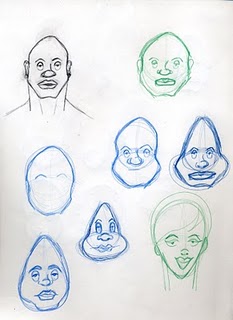
Third, here's some drawings of two of my film's characters. They're roughs, just playing with the shapes of their faces. I've been reading and studying a lot about animation, cartooning and drawing and I'm trying to incorporate this myriad of great information into this next project.
I'll talk more later about which sites and artists I've learned a lot from lately.

Sunday Film Post--Animatic version 3
Finally, I'm uploading at a decent hour on a Sunday!
As I said in my previous post, I have abandoned using ToonBoom's Storyboard Pro due to numerous difficulties and have returned to Adobe After Effects to deal with other difficulties. First on the list is how to adjust the speed of camera moves/transitions. As you can see in this animatic, the zooms start out fast then slow down. I don't want that, I want them consistently paced! I know it involves the "graph editor" which is waaaay scary. So figuring that out is going to take some time.
This animatic has some new and/or improved drawings. Now that I have preliminary character designs, I want them reflected in the animatic. I also decided that the gray, scratchy pencil lines make it difficult to "read" the action so I'm improving that, too.
Thanks to Cablevision, I will be unwillingly missing tonight's Barbara Walters special (not only her last but actually interviewing people I want to see!) and the Oscars. Maybe it's a blessing in disguise--do I really need to be up to midnight or later to see which rich and successful person wins best director and best picture? Will staying up late help me in any way? On the other hand, watching episodes of "The Office" definitely helps me deal better with my own…work situation. :)
Graphic Novel Post--Panel 1 test FINAL!!
I'm all tested out. This version was done with watercolor pencil on Bristol paper with some white ink. I adjusted it slightly using Levels in Photoshop and added the text.
At this point, I think this is solid enough to show to the writer. I want to complete roughs of several more panels for the novel before showing the writer. I'm just glad this splash page is done so and that I figured out a workable method in case the project goes forward.


Toys vs. Boy--Character Designs
These are what I have to date. They will probably be modified in some way during this process but I'm happy with them as a first attempt. Now I can cast them in the animatic!


Wednesday Graphic Novel Post--Panel 1 test II
I think I made a breakthrough. I was struggling to find a way to show the lighting on these buildings. My original idea of using Photoshop gradations looked to soulless. Tonight, after playing with pencils, charcoal and watercolor pencils, I decided that watercolor pencils will work best for me. I'll be able to control the tones and adjusting them in Photoshop will maintain an organic look. A rough test is below.


Sunday Film Post--Animatic version 2
Oops, forgot again! But this time I was with family celebrating Grandma's 90th birthday. At least I have a good excuse!
Below is the latest for the "Toys vs. Boy" rough animatic, the first few seconds.
Wednesday Graphic Novel Post--Panel 1 test
I'm currently collaborating on a graphic novel called "Chalk Outline Man." The story opens with an aerial view of a residential cityscape. To date I've done several test versions with the version below being the closest--so far--to what I ultimately want.
I've spent so much time on this one panel because I see it as a splash page (11" x 8.5" folded in half). Since this is the first image the reader sees--well, the second really, to the cover--it's important to me that it fully engage the eye. I love renderin
gs of cityscapes and am determined to make this one look excellent.
This image is a combination of a rough drawing scanned into Photoshop. The tones were added in Photoshop using a combination of fills, gradients and textures. I'm confident that with some more dedicated effort and experimentation, it'll look great!

Sunday Film Post--Animatic version 1
OK, so it's not Sunday anymore--it's Monday evening--but it's going to take some adjusting for me to get used to this new deadline. At least I'm only one day off!
Below is a brief segment of the first, rough draft of the "Toys vs. Boy" film. The entire first draft of the storyboard was completed during a single spurt of energy and therefore will require numerous revisions. As you can see, the character designs have yet to be determined. I'm still working out the action and the timing so there'll be MANY more versions of the animatic to come.
A New Attitude
One thing that I miss about Bill Plympton's School of Animation is the weekly deadlines. I knew it was important to have something to show every Wednesday. Even though I missed a few Wednesday deadlines, I was constantly working towards that goal.
Not so now! I haven't totally slacked off on my next project, but I don't feel that same sense of urgency.
So I've developed a new attitude and approach. The deadline for completion for my next film, currently titled "Toys vs. Boy," is July 1. In order to meet this deadline, I will be posting the latest work—character designs, energy sketches, animatics, pencil tests, background paintings, etc.—on this blog. I will also be posting the latest work at the Plympton School of Animation, First Class Facebook page which will hopefully generate much-needed feedback from my former classmates.
In addition, I will also be posting the latest work of the graphic novel I'm working on called Chalk Outline Man, a collaboration with playwright B. Walker Sampson.
The "Toys" posts will be made every Sunday and the Chalky posts on Wednesday. I intend to have lots to look at so get ready!
My "Avatar" Two Cents
Since no one's writing about "Avatar," I obviously had to do it. :)
Due to the existence of "Avatar", I had my first 3D IMAX experience. I went to the only true IMAX theater in Manhattan (in all of NYC?), Lincoln Square theater on 68th street and Broadway.

By true IMAX I mean the 70-foot screen, not some retrofitted crap. You need to look out for this: the IMAX corporation is allowing anyone with a projector and sound equipment turned to full blast to call themselves an "IMAX" theater. It's only IMAX if it has a 70-foot screen. Period.
Friends told me that to avoid potentially getting ill and to see the screen properly, it's best to sit as far back and center as possible. We arrived 45 minutes before the show to find that the entire back row was taken (they must've gotten there stupid early!). But we managed to get excellent seats anyway.
I felt sorry for the folks who arrived when the film was starting. IMAX is not the place to be sitting in the first row. That's asking for a neck ache and nausea.
Review-wise, I had lowered my expectations slightly because—based on "Titanic"—I knew that James Cameron was not a consistent screenwriter. Also, I had read so much about the story that it felt overly familiar to the point of me almost being uninterested. Cameron came through with a cliché-ridden script ("you're not in Kansas anymore," "we're getting out of Dodge," yikes!) The story, however, ended up being less common than the script. I enjoyed the obvious criticism of corporate greed and the imagining of the culture and world of the Na'vi.
On a side note, I'm amused by some of the right-wing criticism of the movie. My two favorites are that the film is anti-religion and anti-military. Those critics reveal their own prejudices: first, the soldiers in the film are mercenaries, not U.S. military. They were hired by a private corporation to do a private job. The job that they're asked to do is clear—steal from a peaceful people. I'm fascinated—and repulsed—by a world view that says, "whatever I think, say or feel is always right, no matter what." Clearly those people either do not know history or are purposely ignoring it.
Second, the Na'vi people do have a religion, but I guess their mistake was to believe in something other than Jesus Christ. How dare they! How dare anyone not believe in Jesus Christ! Repeat, arrogant world views.
Admittedly, I have doubts that the 3D approach added to the quality of the film. It was a fun experience, but whenever I raised my glasses to get a 2D look, the visuals were equally entertaining. What impressed me more was the motion capture (or as one of the movie's producers is now calling it, "emotion" capture.) Knowing that the actors performed every movement and emotion before digital enhancement made the film feel special.
Although the film felt 15-30 minutes too long (a complaint I did not have with "Titanic"), I'm glad I saw it. "Star Wars Episode IV," "Titanic" and now "Avatar"—I've been lucky that some of the most technically revolutionary films have occurred in my lifetime.
I'm curious to see where filmmaking goes from here.
Calls of the Wild Premiere with Women in Animation
Last night I had the pleasure of showing my film, "Calls of the Wild," to a small group at the Show & Tell event sponsored by Women in Animation in NYC. And I couldn't have imagined a better response!
First, the women were very friendly from the moment my companion and I walked into the room. This may sound minor, but often members of organizations are cliquish and downright unfriendly. Not these ladies; they immediately introduced themselves and were approachable.
Second, they reacted to "Calls" enthusiastically and supportively. They were effusive in their praise and offered constructive criticism. This was true not only with my film, but with all of the works shown that evening.
I look forward to continuing my association with WIA and to their future events. I think any woman living in the NYC-area who's interested in any aspect of animation should join and participate in this group. There are a lot of talented female animators and WIA appears to be a great support system.
Just more incentive to work hard to get my next projects done. Because that's what it's all about, getting our work out there!
Incentive!
A few days ago I received a courtesy e-mail from Toon Boom Animation, the makers of my recently purchased Storyboard Pro and Animate Pro. They asked if I was using their products and if I'd be interested in having the film I make from their products promoted on their website.
As Madea would say, "Hell to the yeh!"
Not that I've been slacking, but if I was slacking, this is a huge incentive to get going. When I first purchased the software, I read and watched a number of their interviews so being the subject of one would be terrific publicity.
So I'm back to work on my new storyline…right now!!!
First Film Festival Submission
I finally did it.
I've finally realized a dream.
Today I submitted my film, "Calls of the Wild," to the Maryland Film Festival. Hopefully it will arrive by Friday, January 15. Even MORE hopefully, it'll be selected for the festival's program!
Let's all pray to our respective higher beings for that one!
A colleague/friend told me a story today that buoyed my hopes: she was playing my film on her computer at home. Her young adult son was intrigued by the sounds and asked her what was going on. She showed him the film—an unfinished version—and he watched it through—twice—LAUGHING the entire time!
It doesn't get any better than that. :-)
Post-Plympton Project
(I have a thing for alliteration.)
Now that I've completed Bill Plympton's class, it's time to put what I learned to use. I also want to put to use what I learned from the Richard Williams class that I took in 1998! Last century, last millennium! Yeah, it might be a good time to dig those notes out, dust off the book and start drawing.
As I reviewed the Williams notes and book, it occurred to me that there are many animation exercises that I've never done. Particularly, walk cycles. One of my first walk cycles had the left arm and left leg moving together instead of oppositely! Nice. But I must have recovered from that silly mistake to draw this:
Not exactly a smooth walk, but it's something!
Williams thoroughly analyzes all kinds of bipedalism. I really wanted to execute his exercises to learn how they're done. But I didn't want the exercises taking away from creating my next film. So I'm combining the two goals into one: the walking exercises will be made into a story! Simple solution. This way I'll get the experience of drawing humans walking, running, jumping, etc. and will have a completed film for distribution.
There's no time to waste!
Storytelling & Originality
Yesterday I came across an image that's appearing on many blogs…so I thought I'd add it to mine, too!
Below is a story outline comparison between Disney's Pocahontas and Avatar:

I was struck by how much it reminded me of a similar one I saw comparing Star Wars and Harry Potter:

It was eye-opening to read the comments to these comparisons. Some feel that there are clear rip-offs while others see no similarities whatsoever.
I think Nina Paley addresses the subject well here.
Someone said that there's only a handful of story themes (love, revenge, etc.). Every story ever created in the history of man is based on those few themes; their originality is in the handling of the themes, not the themes themselves.
As a film buff, I don't feel as much of a need for new film-viewing technologies as I do for the stories to be changed up a bit. Instead of EVERY MOVIE having a white guy named "Jack" (has anyone else noticed this?) make that character Asian or Latino. Make that character female instead of male. Those small changes alone make a huge difference; the point of view of the protagonist is changed. An Asian woman has most likely lived a different life than white guy Jack and that life will inform her decisions. And people's choices and the results of those choices is the essential element of storytelling.
Ultimately, being an artist is about presenting a truthful presentation of one's point of view. Originality, schmariginality!
Super Duper Software! (I hope…)
Whoops! I know I said I'd talk more about my festival plans TOMORROW and now it's ten days later!
OK, my first New Year's resolution is to be more diligent about this blog.
Before I discuss festival plans, I want to tell you about my new purchases! Because a grown-up buying new software and hardware is like being a kid at Christmas!
I attended a Toon Boom presentation several months ago in SoHo. How would I sum up the demonstration of their software? Jaw-dropping. I don't think I've ever coveted something as much as I did Toon Boom's Storyboard Pro and Animate Pro. I was amazed with the capabilities of these two programs. The company actually has an entire suite of animation products for kids, teenagers, amateurs and professionals.
I had struggled to use After Effects with my last film and was thinking that I needed to switch to Flash. I've heard so much about the vast use of Flash that I figured it was a necessity to learn it if I intend to pursue a career in 2D animation. I even discovered animator Adam Phillips's awesome blog that discussed, among other things, the merits of both Flash and Toon Boom. He created terrific, in-depth (and free!) Flash tutorials. But he also spoke about the benefits of Toon Boom, primarily that, unlike Flash, Toon Boom's software is designed specifically for animation. Flash does animation, but that wasn't it's original intent. As a result, the animator has to fight using it, expending time and energy figuring out workarounds.
Time is vital. And if there's a tool that will make the already tedious job of animating even remotely easier, I'm for it. So I took the plunge and bought both Storyboard Pro and Animate Pro. Thanks, Toon Boom, for the discount! This software is expensive but with the discounts I saved $1200.00. Which I needed to invest in a new computer to run the new software. I have a PowerPC Mac G5 which I unfortunately bought 6 months before Apple switched to the Intel chip. My machine, despite working perfectly, is slowly becoming obsolete. It can't run Snow Leopard…nor Animate Pro. But it will run Storyboard Pro. Why, Toon Boom, why?!?!?!
Anyway, I bought a refurbished white MacBook so I could work while commuting on the bus. It's my first laptop and I'm loving it. Now that I'm done with my Plympton class film (and have taken two weeks to recover from the stress of meeting the deadline) I already have the idea for my next film. And I'm looking forward to getting to know Storyboard and Animate Pro. In future posts, I'll review how well it works.
OK, I'm done gushing about the software that I haven't even used yet!
Next post—festival talk
:30 Short Film—Part 7: GRADUATION!
Yes, ladies and gentlemen, it's finally happened! The first class of Bill Plympton's University of Animation (we started as a school and ended as a university. How's that for progress!) has graduated. Don't believe me? My diploma's below:

Some may not consider this to be much of an accomplishment but those people never made a funny, 30 sec. film in 14 weeks while holding down a day job! About five of the fifteen students had completed films (completed meaning fully animated, color, sound and music) for the final class with several more in various stages of production.
I can say without hesitation that I found Bill's class to be immensely helpful. Since he's doing exactly what I want to do—making a living from independent animated films—the class was full of vital information. I feel more confident pursuing this path as a result of this class. And I even got an original Bill Plympton drawing:

Bill did this in front of the class as a demonstration of drawing purely with shadows, no lines. Everyone in the class left with some sort of Plympton drawing. There were jokes about selling them on eBay but I doubt that's going to happen. We're all too much in awe of Bill's talents to part with our precious drawings.
I'm satisfied with my film although I felt I crammed a little too much story into 30 seconds. I just need to tweak a few things—a character's arm is wonky; credits need to be properly phrased—and then I'm going to enter it into film festivals, starting with the Red Stick Animation Festival. Their deadline is Jan. 4, 2010 so I need to get the film completed and entered by then.
Tomorrow—more about my festival plans…and my next film!
:30 Short Film—Part 6: Final Animation

I could also show photos of my ridiculously messy apartment (even Mom was horrified when she came by during Thanksgiving) but then you'd just think I'm a dirty artist girl.
So it's the last big push for me to finish my BPAS (Bill Plympton Animation School) project. I told myself when I started that I wanted to complete it by December 16, the last day of class. And, darn it, that's EXACTLY what I'm gonna do!
As of this writing, the first 19 of 30 seconds of the film are complete. I basically made the pencil test into the final. I have only one more scene of the hunters to animate and color, then it's on to the ending. I'm still not sure how long the end will take but at this late stage, I want that scene to be as simply staged as possible. I've already decided to cut back on drawing the figures in their entirety in the interest of time. It just needs to be planned.
Below is the latest.
:30 Short Film—Part 5: Pencil Test & Color
Sorry it's been awhile. Lack of blogging is a sign of being busy, VERY busy trying to get this film animated before the last BPAS class on December 16. Since my last post, I have been working on adding inbetweens to smooth the action. As of today, I can say that the progress is steadily getting faster. Despite feeling slightly sick today (I missed spending the holiday with my wonderful girlfriend and her family! *Sniffle*) I was able to get some rough animation done. The product is below. I also got the colors approved by Bill at the last class so I'm happy that I don't have to revisit that. It was a struggle figuring out how to make camouflage not blend into the background! That would, of course, defeat the purpose of seeing the main characters clearly against the background.
Next post—clean animation and more color.
:30 Short Film—Part 4: Pencil Test II
Below is a portion of the pencil test I showed at the last BPAS class. It went over well, thankfully, with only a few suggestions for changes. But one of those changes was significant—more inbetweens! I thought I could get away with doing it the Plympton way, a few inbetweens each on 3 or 4 frames. NOT! I don't yet have the skill nor instinct to do that so it looks like I'll have to take the time to do more drawings to smooth out the action. I knew the movement was stiff and jumpy but, in the interest of time, I was hoping to get away with shortcuts. Guess not!
Next post—extended pencil test.
:30 Short Film—Part 4: Pencil Test
So, after many stressful days (a colleague keeps seeing my scary, red eye and telling me that I "look tired") I finally figured out how to end this freakin' film! It's not ideal, but to tell a funny 30-second story in 14 weeks is an accomplishment in itself (wait, did I say that in a previous post? Sorry!)
Anyway, I have officially started the animating process. I followed Plympton's approach and bought some vellum (or tissue, as Plympton calls it.) This way I can layout and plan various actions with lightweight, inexpensive paper before moving to the regular animation paper. I've already found it helpful when drawing on the bus. Yeah, you heard me right, I draw on the bus. OK, the express bus, but still, it can be done when precision is not needed. But if I've got to commute an hour plus each way, having the vellum and a portable lightbox is incredibly helpful.
I was able to place the figures of Petey and Wayne inside the frame while remaining within the t.v. cutoff area. I'm finding that my drawing of these guys has improved despite not being great. But I'm satisfied that the action that I imagined is actually fitting properly. I also decided that the action would often be limited. The first scene with the hunters is 29 frames. So there won't be much happening besides eye and eyebrow movement.
Next post—pencil test animation of Scene 2.
:30 Short Film—Part 3: Revised Animatic III
Wow, FIVE WEEKS!! It's taken me FIVE WEEKS to figure out how to frame the punchline of this film. I hope it was worth it!
At first I was beating myself up over it, being overly critical, telling myself that I should've figured it out a lot sooner. Then a truth hit me: this is only my second time telling a story with a punchline and my first on a 14 week deadline! There's all kinds of framing, continuity and readability issues involved that I haven't had to deal with in the past. So all things considered, taking five weeks to determine the best solution to the problem maybe isn't so awful.
The good news is that I HAVE figured it out and now I'm ready to start animatin'! The goal for the next class is to have a completed, final animatic that includes between 3-5 seconds of pencil test animation. I'm confident that the goal can be met.
Below is the first 20 seconds of the final animatic. I forgot to warn you before: this is NSFW (not safe for work) due to the sound effects.
At first I was beating myself up over it, being overly critical, telling myself that I should've figured it out a lot sooner. Then a truth hit me: this is only my second time telling a story with a punchline and my first on a 14 week deadline! There's all kinds of framing, continuity and readability issues involved that I haven't had to deal with in the past. So all things considered, taking five weeks to determine the best solution to the problem maybe isn't so awful.
The good news is that I HAVE figured it out and now I'm ready to start animatin'! The goal for the next class is to have a completed, final animatic that includes between 3-5 seconds of pencil test animation. I'm confident that the goal can be met.
Below is the first 20 seconds of the final animatic. I forgot to warn you before: this is NSFW (not safe for work) due to the sound effects.
Subscribe to:
Posts (Atom)